 On one of our scooter rental days in Kep, we rode west to Kampot town to check it out. The first stop was a cafe where we met locals and expats working together on a vision of starting a school out of town for the families of impoverished fishers. It will include a community garden to help with nutrition and space for music and the arts. Soon is the lovely person behind this and other initiatives (see pamphlet to the left).
When searching the web to learn more about Kampot, it was apparent that there are also a number of NGOs providing services. This immediately felt like a place we could stay for a while. Indeed, as our time in Kampot went on (a total of 9 days), the feeling grew, and a return for several months may be in the future. It has a feeling of home.
Kampot has a large branch of the Cambodian Red Cross, spanning at least a couple of buildings across from the waterfront. Big banners proclaim its priorities are maternal-child health, working with youth and working to reduce morbidity and mortality from scooter and workplace accidents.
One of the Red Cross buildings pictured below

Kampot town is the capital of Kampot province in the southwest of Cambodia. The province is known for its durian fruit, salt, Kampot black pepper, fish sauce and rubber production, as well as some forestry and mining. During the terrible reign of the Khmer Rouge, almost a hundred thousand Cambodians in Kampot province were massacred,
 |
| Durian is celebrated at the centre of this traffic roundabout in town |
 |
| This traffic roundabout recognizes the contributions of salt workers |
Swallow Farming
With the price of swallow nests rising on the international market, the Cambodian government is encouraging farmers in Kep, Kampot and Sihanoukville to invest in swallow farms. Once a farmer has land and a concrete building with loudspeakers to emit swallow sounds, they are in business as the swallows capture their own food. This enterprise will do two things: protect the swallow population and increase the income of local farmers.
Swallows nest 3x/year. 100 nests = 100 kg of nest material to sell. One kg can fetch $4,000 to $6,000 USD on today's market. Products made from swallow nests are considered to have healing properties, to be good for lung and skin diseases and for the elderly.
Are you thinking of bird's nest soup? No. Nests from the swiftlets, a relative of the swallow is used for soup. Swallow's nests are used mostly to make beverages; some drinks are alcoholic and some not.
Here's an ad for a non-alcoholic drink that I found on the Internet - note the price:

Here is a typical-looking farm:

Kampot town is situated on the Praek Tuek Chhu River. Being only 5 km from the Gulf of Thailand, it was an important shipping area until Sihanoukville was developed. Under the reign of the French, Kampot town was also a regional capital, and there are many old French colonial buildings, rather worse for the wear, but still standing and functional. Kampot was and is a very multi-cultural city with Chinese, Malay, Vietnamese and other mixed communities. We have been eating at an excellent Malay restaurant here, but food from many nationalities is available.

To walk downtown, we walk in the park between 724 and 724a streets. It's a promenade with old French colonial homes and buildings known as Chinese Compartments, where the ground floor opens onto the street for commercial activity while the shopkeeper and family live on the first floor. These buildings are usually 3 to five meters wide and up to 25 meters long. As we get ready to leave Kampot, workers are getting two sections of the park ready for the 3-day annual Cambodian Sea Festival that features food. Food booths are being erected on both sides of the walkway.
Night one at the Monkey Republic Hostel turns out to be not what we want, as smoking is permitted in all public spaces of the hostel, and once the afternoon rolls around, the music is cranked to 10+ until late into the evening. They are very gracious when we say we need to leave and reimburse us without penalty. A move half a block down the street lands us at the Kampot Guesthouse, one of the only places in town with a pool ... heaven.


Monkey Republic has a great kitchen; however, we go back there often to eat, choosing outdoor seating when we can find it.

Shortly after arrival, there is an artisans' festival held in the yard of a Guesthouse called The Playground. Proceeds from this fair go primarily to programs that educate young children. We run into two people we have met before and chatted for a while before I buy some cheap jewellery for the cause. There's a rooftop bar with a small menu, a newly installed swimming pool and friendly owners. We like this place and have returned a couple of times.

Sight-seeing Tour
A tour is in order one day with nothing on the 'to-do' list.
The van that took us to the top of Bokor Mountain was in such rough shape that the driver had to turn off the air conditioning as it took too much power away from climbing the 1,075-meter hill. Afterward, Paul wished we had just rented a scooter and done it ourselves, but I had read that many tourists are injured and killed every year on this crazy winding road.

So we head up to Preah Monivong Bokor National Park.
Bokor was developed by the French as a summertime mountain retreat for the wealthy. It is now faded, crumbling and mostly destroyed from the fierce fighting in the time of the Khmer Rouge.
The Black Palace, our first stop, was once the summer retreat of King Sihanouk. In the museum, days later, there is a photo of the Royal Family picnicking on the grounds of the palace. Today, it is such a ruin that one would never know the name was derived from the black Italian marble floors that were once throughout the palace.
The walls are covered in graffiti ...

... but the views remain spectacular. We can see Rabbit Island and even as far as Phu Quoc, Vietnam, from here.

 |
| In and around the Palace |
 |
| The Black Palace |
The next stops are called as one: "The Ghost Town" and comprise a church, a pagoda and the Popokville waterfalls.
The Church is where the French Catholics came together for Sunday Mass.


There's a stop at the Lok Yeay Mao monument. She is a heroine in the form of Buddhism found in the coastal provinces of Cambodia. The monument below, inaugurated in 2012, stands 29 meters tall.


Another stop on the tour is the Wat Sampov Pram complex, made by King Monivong Sisovath. It remains a working temple to this day, and on a clear day, you can see all the way to Sihanoukville from the temple hilltop.
Buildings in the temple complex:


Inside the main temple


The final stop for this portion of the tour is the waterfalls, which are probably more spectacular in the rainy season. It's a pleasant enough site to eat our boxed lunch that comes with the tour. There are a couple of massive and mostly empty buildings here. We can buy a drink to go with our lunch. If a drink is not purchased, people are charged $5 to sit at a picnic table and chairs. I think this is because Cambodians love to picnic and they come prepared with everything - no purchases needed. We do see several families laden down with food and drink.

The rickety tour van makes it down the mountain intact. We have a few hours off, then a sunset cruise on the river and after dark, we can see fireflies.
Meanwhile, one of our favourite activities at about 4 in the afternoon is to watch the fishing fleet heading out to sea.


The dinner cruise boats are kitschy, but their bright LED lights in the perfect darkness, reflected on the water, are lovely to see:


Kayaking
One sunny afternoon, it's a tuk-tuk ride 4 km out of town to the Retro Kampot Guesthouse to rent a kayak to glide through the "Green Cathedral". The green palms on both sides of the riverbank are so tall their tops bend gently to form a canopy over the water. Going softly through this green jewel of a tunnel is a peaceful experience, broken with the whir of dragonfly wings and backed by birdsong. We are mostly in the narrow waterways of the mangrove system, but do get out onto the main river.


After the paddle, we had lunch at the Retro, a delicious Khmer salad, then wandered their property and took a few photos of their cabins. The owner sat with us for a while and made some suggestions of things to see and do in Kampot. He also went and shooed a snake out of the bathroom when I wouldn't get changed with the creature in the room. Said it was harmless.
When we left Retro Kampot Guesthouse, the host called us a taxi on an App that is fairly new in Cambodia. It works in many major towns and cities for both tuk-tuks and taxis, and is less expensive than usual rates. Read about it here: Pass App.
We celebrated our 35th wedding anniversary in Kampot town.

Kampot Museum
Forty-five minutes one afternoon is enough time to see the tiny Kampot Museum. The museum is in a building that in the 1920s was the Governor's mansion. It's since been renovated but retains its beautiful French colonial style.
 |
| Governor's Mansion Museum today |
Some items from the Museum collection:
This photo of what was a fish market in the 1930s and is now an upscale riverside seafood restaurant and bar by the same name, where one can watch the sunset and fish boats heading out to sea:


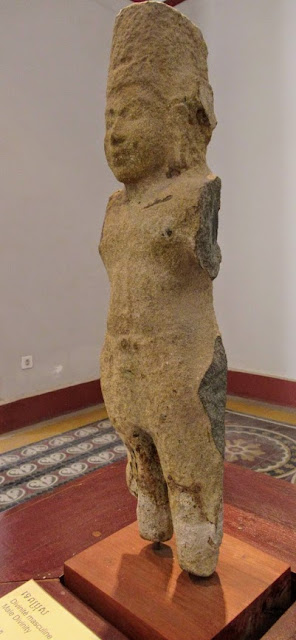
Kampot Art Gallery
This photo of what was a fish market in the 1930s and is now an upscale riverside seafood restaurant and bar by the same name, where one can watch the sunset and fish boats heading out to sea:


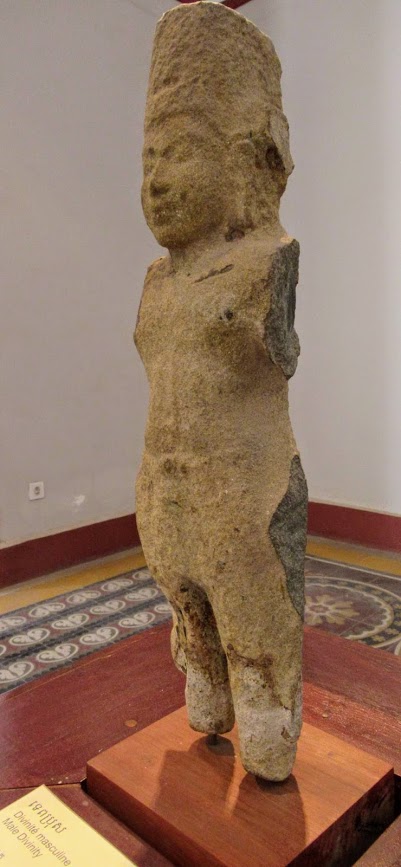
Kampot Art Gallery
This small, contemporary art gallery located in a beautiful building features up-and-coming Khmer artists' exhibits. For sale are eco-friendly clothing, jewellery, and more, much of it made from recycled materials.
Here's a creative display of handmade and painted fish for sale:

Out walking one day on some back streets and came upon a temple. It seems as though the monks welcome poor people to live on the periphery of the temple grounds. Here are some photos of the grounds:

Bicycling
Rented bicycles today. Two dollars per person. Rode first across the old (scooter) bridge, then hang a left and over another bridge to Fish Island. Watched guys with five-foot-long blocks of ice deal a couple of solid blows with a hatchet to break it into three pieces, then slide the blocks down a wood chute to the dock, where others would load the blocks into the fish boats.


Wound our way through neighbourhoods, then came upon the serene Wat Try Koh by the river. A service was going on, so we did not get into the main temple. What a beautiful location this is.


Time to eat, so off to The Playground for lunch and a cold draft. This time, we meet Amanda, Steve's wife. Do yourself a favour, if you're ever in Kampot, stop by for a beer, food and some of their wonderful hospitality. Perhaps even stay in their Guesthouse.
Then for exercise, we bike north along that west side of the river before turning back to return over the old bridge and bike the Kampot town side of the river to the south.

On the way back to town, there's a quick stop at Lotus Pond. It appears that all of the flowers have been harvested.

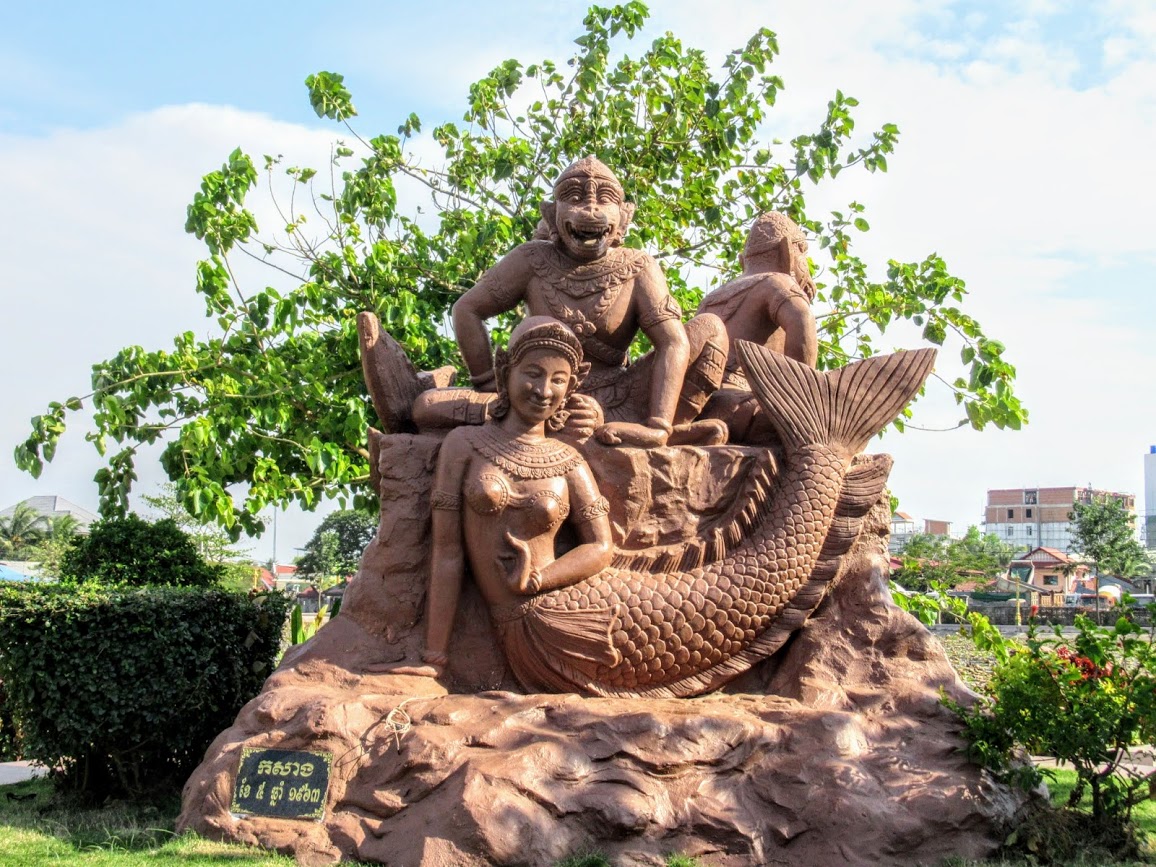
Back in town, we stop at the free La Plantation Pepper Grinder Museum. It's supposedly the only museum in the world dedicated to the history of the pepper grinder. La Plantation is a huge pepper farm between Kampot and Kep. I loved their displays of pepper grinders and pepper storage containers.


The museum notes how pepper grinders moved away from being purely functional to more like works of art for display in the 1950s and 1960s. They were also personalized with company logos, especially by vineyards as an advertising medium or for intimate personalization for gift-giving.
There are beautiful modern grinders created by famous Italian designers. There is much said about the quality of the Peugeot grinders.
 |
| Pepper storage containers |
I think I like Cambodian food even better than Thai food. Dishes like: Sweet and Sour Soup; Green Mango Salad; Beef Lok Lak; Noodle Soup; Banana Flower Salad; Grilled Pork and Broken Rice; Khmer Noodles; and so much more.
Of the traditional recipes we've tried, Seafood Amok has to be one of my favourites with its subtle flavours and creamy taste. Here's a recipe: Fish Amok Recipe
Kampot News
We read that Kampot town has been granted city status. Whenever that comes into effect, it will mean government dollars for infrastructure, a big boost for Kampot. The town is going ahead with public and private projects now. It looks like there's a new bus station going in. There's now the Campot Cruise Line that 3x/week can whisk you away to islands like Koh Ta Kyiv, Koh Rong, Koh Rong Samloem, and Koh Thmei without ever having to go to Sihanoukville.
We'll Be Back
One day, near the end of our stay, we cross paths with a neighbour who lives across the road from our guesthouse. He stops to chat and wants to know how long we have been in his country and city, and what we think of it. We love Cambodia and especially Kampot, so it's an easy conversation.
In the end, he says, "You are Cambodia Happy."
Yes. Exactly. We are:

Until next time, Cambodia.
Off now to Phu Quoc Island, Vietnam, for a month. Christmas and New Year's on an island!
Random Photos Kampot


 |
| Places to go |

It's wedding season in Cambodia, and these pop-up wedding tents are busy. In Kep, our guesthouse host ran out of our favourite beer (Cambodia). He said it is the preferred beer amongst local people too. He ran out because it's wedding season, saying that a wedding generally orders one case of beer for each guest present ... even though many women don't drink, or drink very little.

As we near the end of our 30-day visa here, Christmas is in the air.


